Context and Criteria
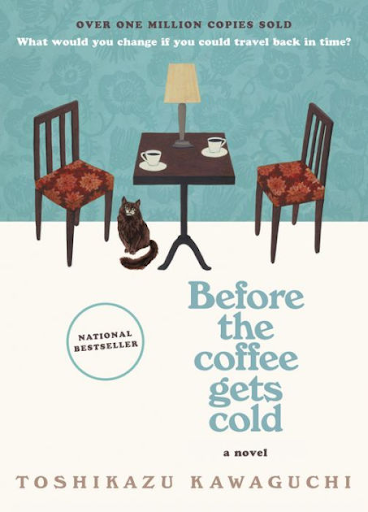
Before The Coffee Gets Cold is a short contemporary fictional novel written by Toshikazu Kawaguchi. It is written with a clean and straightforward tone but carries a very complicated message that is displayed beautifully as the story unfolds in four parts. To share my opinion, there will be categories in which it is ranked. Starting with an overview of the story itself, keeping it usually spoiler-free or with minor spoilers. Then, a literary analysis of the text is conducted on the style and quality of the writing itself. And lastly, my overall impression, and then if I, as a reader, would recommend it to other readers- these sections might feature some spoilers for those who plan to read the book.
Book Overview (Spoiler Free)
The book introduces characters who play a part in visiting or working for a small cafe located in Tokyo. The author introduces the idea that this specific coffee cafe has a unique and imaginative quality that is rumored to be a way to time-travel. Each part of the book centers around a different visitor and their reasoning for wanting to travel to the past. By the end of the book, all the stories come together and find some way to tie each other to one another. Throughout the story, these characters learn the required (and annoyingly tedious) rules that come with the process of traveling to the past, and more importantly, the lessons that come from it.
Literary Analysts / Writing Quality
From a surface-level point of view, this short novel could be mistakenly labeled with a streamlined or simple form of writing. The book’s style of writing- in a literal sense- lacks depth, if you associate depth with more poetic lines, such as imaginative metaphors. Truth be told, the writing is simple. But as someone whose favorite part of reading is highlighting specific lines, it surprised me that this quick-paced, formatted style of writing didn’t degrade the quality at all. In fact, a couple of points became obvious. One being that the plotline of the story was quite complicated and a little confusing at times, therefore complicated writing wouldn’t have matched the story’s vibe, but would have actually distracted the reader away from the importance of the plot. And two, it is often common for authors to use good literary devices and wording over a bad plot to deceive the audience. That is not the case with this book, however. The style of writing only further proves the point that the book is rewarded for its well-made story, without outstanding literary qualities. It should also be noted that the book was not originally written in English, but was translated from Japanese to English.
My Verdict
The concept of Before The Coffee Gets Cold is meant to be strange and unique. It runs through many themes in a tangled way that unties itself the more you read. Throughout the first part of the book, the way the author chose to write the characters was odd. One of the first characters we meet is named Fumiko. She wants to return to the past to change her decision of letting her boyfriend walk away. She is impatient and impolite at times, especially when learning the strict rules that come with time traveling, and she becomes frustrated quite easily. This is a common theme among the others as well. However, this is completely intentional. The people in the story are written to be relatable and have traits that are unlikable but realistic. It makes the relationships in this book stronger, as if a lesser appeal to someone can actually make you more touched by what someone else sees in them. It makes the relationships feel more personal and private, and as the reader, you don’t have to understand its concept to feel the emotional depth of its fallout.
One of my particular favorite things the author does is how well it’s all tied together. With the book being split into four parts, each section explores a new set of groups or couples, and what their intentions are with returning to the past. In these parts, the author includes topics that don’t quite fit that section or feel unnecessary to the plot in that moment. Once again, this is completely intentional and is meant to foreshadow the next part. It is very satisfying to watch something that felt a little out of place later get explained more and more until it completely fell together in the end. At the beginning, the story’s pacing felt like maybe the organization wasn’t clean enough, but later it became very enjoyable, unfolding the story the way it was so carefully intended.
Would I Recommend?
To keep my answer short and sweet- YES. Tons of books targeted to teenagers today are very similar and teach similar lessons with the same, dare I say, “copy-and-paste-characters”. Nothing is wrong with a little repetitiveness; however, it is important as a reader to experience all sorts of different genres to open your eyes to something you might not know you needed to hear until now. Reading is about understanding people as characters you’ll never meet, and this book demonstrates that perfectly. If you’re looking for a book whose whole purpose isn’t trying to stand out by going to extreme and unrealistic standards, but by telling a story through everyday people’s experiences in regret, loss, love, and hardships, this is the book for you. Sometimes, books go to those levels purely to get the reader to feel something. But this story, simply unfolded in such a natural way, that the connections, bittersweet relationships, and feelings of loss were natural and authentic. It felt so real and written in a way that wasn’t meant to make me upset, but rather in a way that encouraged whatever feelings followed with it.